When your primary language model fails or hallucinates in production, your system shouldn't crash. Learn how to design deterministic fallback paths and auto-recovery loops.
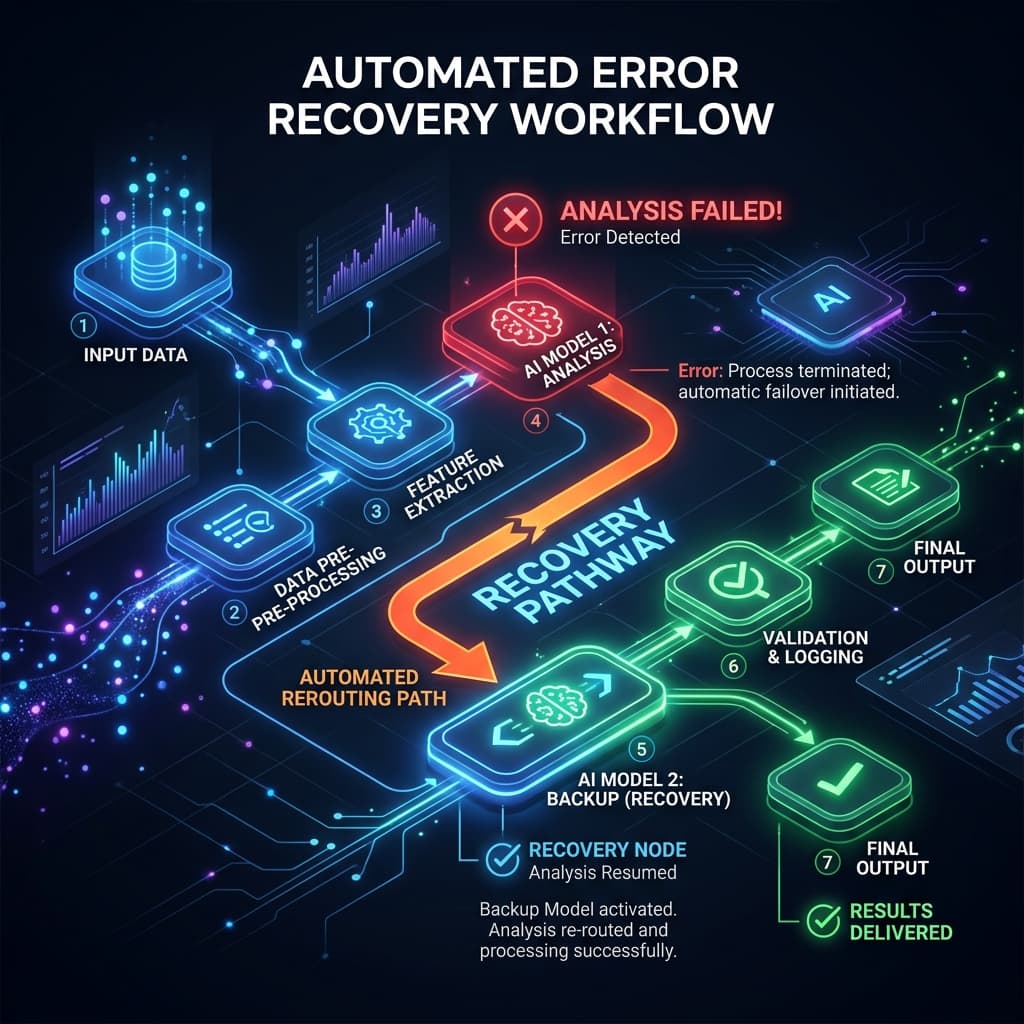
Language Models fail. It’s not a question of if, but when. Often, you will see timeouts from the API provider, structurally malformed JSON returns, or outright hallucinations. An application built with a single, linear AI path is fragile by definition.
Designing the Fallback Loop
Enterprise AI architecture mandates multi-tiered error handling. If a process analyzing user data fails the expected schema validation, the system should immediately initiate a failover sequence. This can mean falling back to a lighter, faster model (like Claude Haiku or GPT-4o mini) for a retry, or rerouting to a purely deterministic code rule set.
- Validation Nodes: Every LLM output must pass through a strict JSON schema validator before proceeding downstream.
- Retry Queuing: Implement exponential backoff for rate limits and transient errors.
- Circuit Breakers: When failures exceed a threshold, temporarily disable the AI feature entirely and default your UX to its graceful fallback state.
A reliable system is distinguished not by its lack of errors, but by its grace in handling them. Incorporating logical failovers into AI workflows creates the resilience required for true production environments.